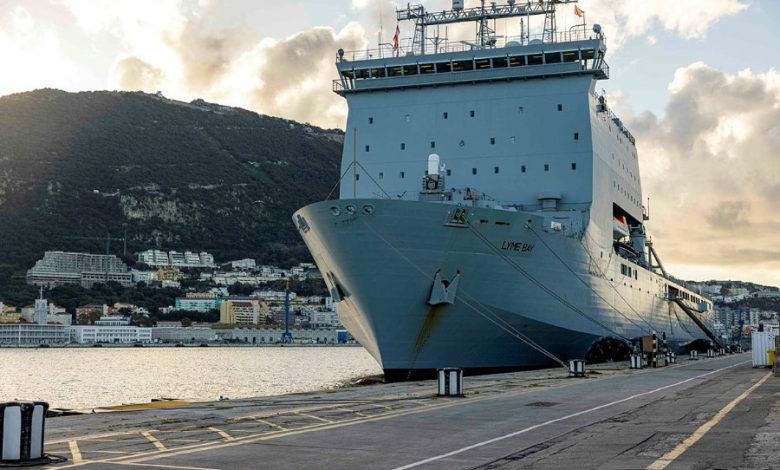
The UK is planning to retrofit a Royal Navy evacuation vessel with mine-hunting capabilities for possible deployment in the Strait of Hormuz.
Britain’s move comes amid sharp criticism from US President Donald Trump, who lashed out at NATO allies over lack of involvement in his war with Iran, calling the bloc a “paper tiger.”
Hormuz Mission
The UK is equipping the RFA Lyme Bay Auxiliary Bay-class amphibious support vessel with autonomous underwater drones which can detect and neutralize mines.
The Times newspaper reported, citing sources, that Defense Secretary John Healey instructed the development of plans for deploying the vessel in the Arabian Gulf, possibly to reopen the Strait of Hormuz.
However, a defense source noted that “no decision” had been made regarding the deployment of RFA Lyme Bay to Hormuz. “This preventative step gives ministers options should they be needed to help resume the normal flow of merchant shipping,” the source said.
Mine-Hunting Readiness
The Royal Navy unveiled on Sunday plans to boost its mine-hunting capabilities by adding new cutting-edge uncrewed equipment to RFA Lyme Bay in the coming days, as part of the Navy’s transition to a “hybrid navy.”
This equipment will be capable of detecting, identifying and neutralizing threats, enabling Lyme Bay to “store, prepare, deploy and recover a variety of autonomous and crewless technology, from underwater drones to mine-hunting boats – acting as a crewed ‘mothership’ for drone tech,” the Royal Navy said in a statement.
“RFA Lyme Bay preparing for a possible mine-hunting mothership role is a perfect example of how we are building a Hybrid Navy – one where crewed ships and cutting-edge uncrewed systems work together seamlessly to keep our people safe and our seas secure,” First Sea Lord, General Sir Gwyn Jenkins, said.
Strait of Hormuz Blockade
The Strait of Hormuz is a crucial waterway linking the Arabian Gulf with the Gulf of Oman and the Arabian Sea, serving as the main shipping route for crude oil from the Gulf region to the rest of the world.
Around a fifth of daily global oil supplies (about 20 million barrels per day), as well as a fifth of global liquefied natural gas (LNG) supplies, pass through the Strait of Hormuz, according to the US Energy Information Administration (EIA).
The US-Israeli war with Iran has caused traffic disruption in the strategic waterway, as Iran warned it would not allow “enemy ships” to cross the Strait. It also threatened to deploy naval mines across the Arabian Gulf to cut routes in case the US invaded its southern coast and islands.
Trump’s Deadline
The US has ramped up its military presence in the region to protect navigation and secure passage through the Strait, amid reports of a potential ground operation in Iran.
Against the backdrop of ongoing negotiations, Trump extended his deadline for Iran to open the critical corridor until April 6, or the US “will hit and obliterate” Iranian power plants.
Trump also called on NATO and US allies to send warships to the region to escort commercial tankers through the Strait of Hormuz. However, several nations have shown reluctance to do so.
Multinational Efforts
On March 19, more than 30 countries, including the UK, France, Germany, Canada, Australia and the UAE signed a joint statement, voicing “readiness to contribute to appropriate efforts to ensure safe passage through the Strait.”
Moreover, the UK has offered to host an international security summit to come up with a “viable, collective plan” to reopen Hormuz once the conditions are right.
Similarly, France’s military chief held talks with counterparts from over 35 countries via video conference to discuss a defensive initiative to organize the resumption of shipping through the Strait of Hormuz once hostilities cease, the French Defense Ministry said in a statement.