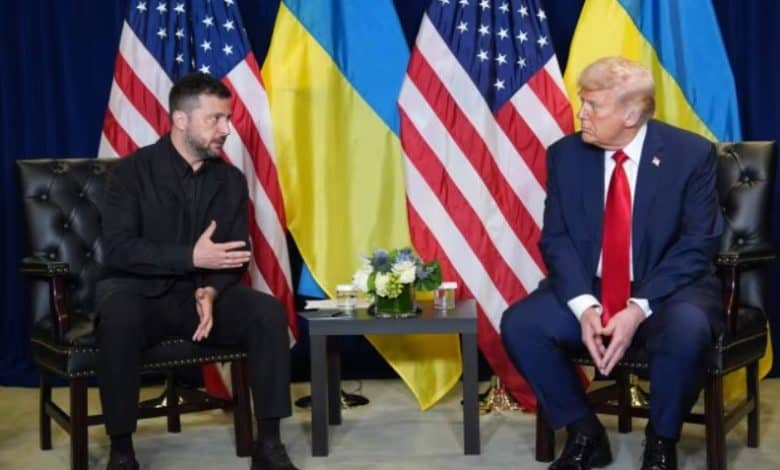
The US President, Donald Trump, has given Ukraine until Thursday to accept a proposal to end the war with Russia.
Trump’s 28-point peace plan, crafted by his administration and the Kremlin, includes territorial concessions and a commitment from Ukraine to forego joining NATO. It also includes some terms that Moscow could find unacceptable.
Short Deadline
On Friday, Trump gave Ukraine one-week deadline to accept the proposal. Speaking to Fox News Radio, he said that Thursday was an appropriate deadline for Ukraine to agree to the peace plan.
Later, he explained to reporters that the tight deadline is due to the urgency to end the fighting before winter, stressing that the Ukrainian leader, Volodymyr Zelensky, have no choice but to accept the proposed plan, reported Reuters.
“He’ll have to like it, and if he doesn’t like it, then you know, they should just keep fighting, I guess,” Trump said. “At some point he’s going to have to accept something he hasn’t accepted,” he added.
Trump also mentioned the fiery encounter with Zelensky at the White House in February 2025. “You remember right in the Oval Office, not so long ago, I said, ‘You don’t have the cards,'” he noted.
Trump’s Peace Plan
Trump’s Special Envoy, Steve Witkoff, drafted the 28-point peace plan, with contributions from US State Secretary, Marco Rubio, and Trump’s son-in-law, Jared Kushner.
Moreover, Witkoff consulted with Russian envoy Kirill Dmitriev on the plan, Axios reported. It also noted that Witkoff and Kushner discussed the plan with Zelensky’s national security adviser, Rustem Umerov.
However, Umerov denied agreeing to any of the plan’s terms and said he had played only a technical role organizing talks, according to Reuters.
Key Points:
Territorial Concessions
The plan’s draft, as seen by several media outlets, consists of 28 key points, many of which agree to Russia’s demands, including ceding significant territory – demands that Zelensky has consistently rejected.
While the plan confirms Ukraine’s sovereignty, it proposes that Crimea, Luhansk and Donetsk will be recognized as de facto Russian lands, including by the US.
Ukrainian forces will withdraw from the part of Donetsk Oblast that they currently control, and this withdrawal zone will be considered a neutral demilitarized buffer zone, internationally recognized as territory belonging to the Russian Federation. Russian forces will not enter this demilitarized zone.
Additionally, the borders of Kherson and Zaporizhzhia regions, which Russia has partially occupied and claimed as its own, will be frozen along the frontline.
In return, Russia will also relinquish other territories it controls outside the five regions.
The IAEA will supervise the Zaporizhzhia Nuclear Power Plant and electricity produced will be distributed equally between Russia and Ukraine.
NATO & Security Guarantees
Under the plan, Ukraine must enshrine in its constitution a commitment not to join NATO, and NATO adopts a provision that Ukraine will not be admitted in the future. The military alliance also agrees not to station troops in Ukraine.
The size of the Ukrainian army will be limited to 600,000 soldiers, and Ukraine will receive reliable security guarantees. Moreover, Russia commits not to invade its neighbors, while NATO refrains from further expansion.
Ukraine will hold elections within 100 days. The implementation of the agreement will be monitored and guaranteed by the Peace Council, headed by President Trump. Ceasefire will take effect once all parties agree to the plan.
Economy & Reconstruction
The plan gives Ukraine a powerful global package of measures for the rebuilding process, including the creation of a Ukraine Development Fund to invest in fast-growing industries.
Furthermore, $100 billion of Russia’s frozen assets will be invested in US-led efforts to rebuild and invest in Ukraine, with the US receiving 50% of the profits and Europe adding $100 billion in investment for reconstruction.
The plan also calls for Russia’s reintegration in the global economy, by lifting sanctions, forging a long-term economic cooperation agreement with the US, and inviting Moscow to rejoin the G8.
Ukraine’s Response
The US-proposed peace plan has put Ukraine between a rock and a hard place. In response to the plan, Zelensky warned on Friday that his country may face a difficult choice between losing its dignity and freedom or the support of its most important ally, the US.
Reassuring Ukrainians he will never betray Ukraine, Zelensky called for unity, saying that Ukraine “can face a very difficult choice — either losing dignity or risk losing a major partner.”
He added that he “will fight 24/7 to ensure that at least two points in the plan are not overlooked – the dignity and freedom of Ukrainians.”
Moscow’s Reaction
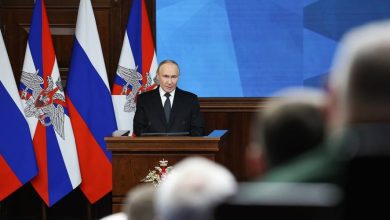
The Russian President, Vladimir Putin, expressed readiness to discuss the US peace plan, reported Russian News Agency (TASS).
During a Security Council meeting on Friday, Putin said that the US peace plan could serve as “the basis” of a final settlement to end the conflict, accusing Ukraine of being not willing to accept it.
Meanwhile, the Kremlin Spokesman, Dmitry Peskov, said that the level of contacts between Moscow and Washington to discuss the plan has yet to be determined.
Europe’s Position
European leaders have reaffirmed their strong support for Kyiv, following reports of the new plan. After a call with Zelensky, the leaders of Germany, France and the UK reiterated their “unwavering and full support for Ukraine on the path to a lasting and just peace.”
Regarding the US peace plan, they welcomed the commitment to Ukraine’s sovereignty and the willingness to provide Ukraine with robust security guarantees, according to a joint statement.
However, they stressed that the current line of contact should serve as “the starting point for any understanding and that the Ukrainian armed forces remain capable of effectively defending Ukraine’s sovereignty.”
They also said that “any agreement affecting European states, the European Union, or NATO requires the approval of European partners or a consensus among the allies.”
Furthermore, the EU foreign policy chief, Kaja Kallas, described the plan as a “dangerous moment for all,” reaffirming the bloc’s position on territorial concessions.
“We all want this war to end, but how it ends matters. Russia has no legal right whatsoever to any concessions from the country it invaded,” she said.