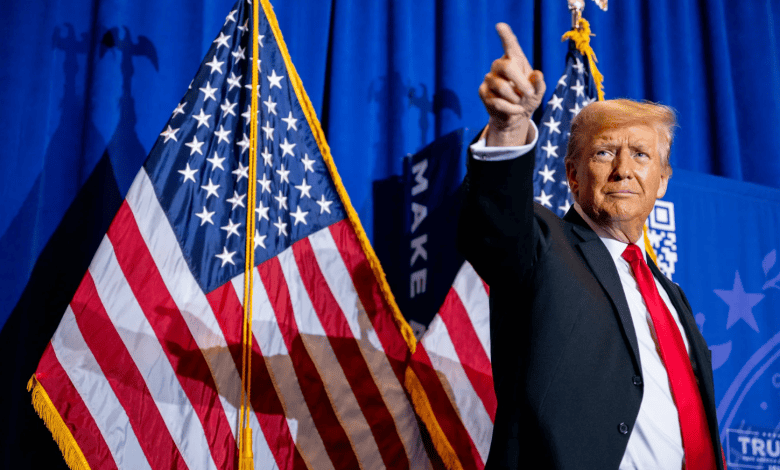
The US President, Donald Trump, announced on Monday that the US will hold direct talks with Iran regarding its nuclear program, reported the Associated Press (AP).
Trump said that Tehran cannot possess nuclear weapons, warning that negotiations’ failure will put the Iranians in great danger. On its part, Iran said that it will only engage in indirect talks.
US-Iran Nuclear Talks
Speaking to reporters at the White House’s Oval Office after meeting Israel’s Prime Minister, Benjamin Netanyahu, the US President said the talks with Iran will begin on Saturday. “We’re dealing with them directly and maybe a deal is going to be made,” he said.
Trump added that “doing a deal would be preferable to doing the obvious,” warning that “Iran is going to be in great danger” if Washington does not reach an agreement with Tehran. “If the talks aren’t successful, I think it’s going to be a very bad day for Iran,” he added, referring to the possibility of a military action.
Iranian Response
On the other hand, Iran insisted that the talks with the US will take place in the form of indirect discussions. The Iranian Foreign Minister, Abbas Araghchi, revealed that indirect talks will kick off on Saturday in Oman.
“Iran and the United States will meet in Oman on Saturday for indirect high-level talks. It is as much an opportunity as it is a test. The ball is in America’s court,” he wrote on X.
Oman has been a crucial channel of communication during previous US-Iranian negotiations. However, the Middle Eastern country has not announced it will host the upcoming talks.
Iranian state media reported that the talks will be led by Aragchi and US Envoy to the Middle East, Steve Witkoff, with the attendance of Oman’s foreign minister, Badr al-Busaidi, according to Reuters.
Negotiations Proposal
Trump has repeatedly called on Iran to abandon its nuclear program, threatening severe consequences if they develop nuclear weapons.
In December 2024, the International Atomic Energy Agency (IAEA) Chief, Rafael Grossi, told Reuters that Iran is “dramatically” accelerating its enrichment of uranium to up to 60% purity, close to the roughly 90% level that is weapons grade. Meanwhile, Iran insists that its nuclear program is for civilian purposes only.
On March 7, 2025, Trump said he had written a letter to the Iranian Supreme Leader, Ayatollah Ali Khamenei, suggesting direct negotiations over Tehran’s rapidly advancing nuclear program.
However, Iran’s President, Masoud Pezeshkian, stated that Tehran had rejected Trump’s offer while leaving open the possibility of indirect negotiations with Washington.
The last direct high-level talks between the US and Iran took place in 2025, when the then-US Secretary of State, John Kerry, and then-Iranian Foreign Minister, Mohammad Javad Zarif, worked out the details of the Iran nuclear deal, according to CNN.
Military Action Threats
In response to Pezeshkian, the US State Department said that “Trump has been clear: the United States cannot allow Iran to acquire a nuclear weapon.” It also signaled the possibility of a military action, according to AP.
“The president expressed his willingness to discuss a deal with Iran. If the Iranian regime does not want a deal, the president is clear, he will pursue other options, which will be very bad for Iran,” it added.
Furthermore, the US President threatened Iran with military action in late March. “If they don’t make a deal, there will be bombing. It will be bombing the likes of which they have never seen before,” Trump told NBC News.
During his first term in office, Trump unilaterally withdrew the US from the 2015 nuclear deal with Iran, which aimed to curb Iran’s nuclear progress in exchange for sanctions relief. After his return to power, Trump re-imposed sweeping sanctions on Tehran. He has also been sending more military assets to the Middle East amid escalating tensions.