
The big picture: Sau Saudi Arabia accelerates its ambitious economic diversification agenda across the region, as the Kingdom champions industrial localization across the entire country with great passion.
Driving the news: The General Authority for Statistics (GASTAT) announced on Tuesday that its preliminary Industrial Production Index rose 15.6% month on month. Mining and quarrying led the recovery, while manufacturing also gained ground. The index reached 101.3 points, up from 87.7 in August.
Zoom in: Manufacturing output rose 2.8% from August. Coke and refined petroleum products climbed 7.0%, and chemicals added 0.8%. Meanwhile, the mining and quarrying sub-index surged 29.1% as oil activities recovered.
Behind the rebound: Vijay Valecha, chief investment officer at Century Financial, said crude volumes recovered as Saudi Arabia expanded ship-to-ship transfers beyond the Strait of Hormuz and routed more crude through Yanbu on the Red Sea. The Kingdom also used the East-West pipeline to keep exports moving.
Between the lines: Annual comparisons set the recovery in context. The index stands 10.9% below its September 2025 level. Mining and quarrying slipped 16.0%, and manufacturing eased 5.4%. Refined petroleum products fell 13.6%, while chemicals declined 3.8%. Arab News reported that regional energy-market disruptions since February shaped these swings.
Electricity, gas, steam and air-conditioning supply rose 6.4% year on year, and water, sewerage and waste management grew 7.3%. However, both sub-indices dipped month on month, by 1.2% and 0.4% respectively. However, oil activities fell 15.5% year on year but rose 24.7% from August. Non-oil activities edged up 0.1% annually and gained 0.6% monthly.
Localization Drives Diversification
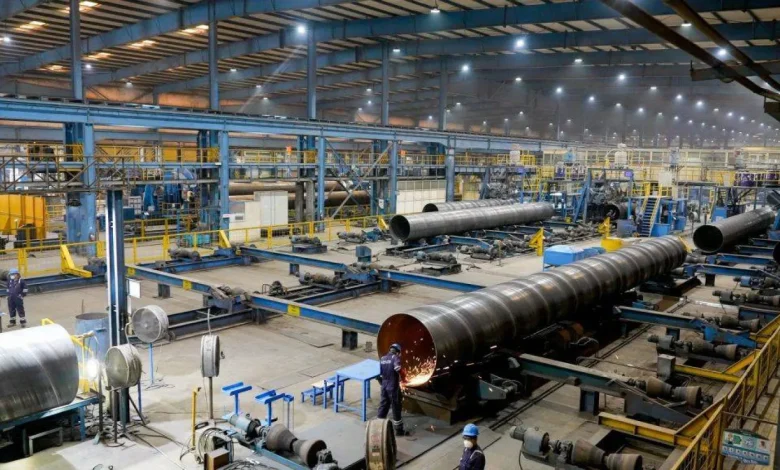
Why it matters: The monthly rebound owes much to oil-linked output. Nevertheless, Saudi Arabia’s longer-term plan targets factories as well as wells. Vision 2030 pushes the Kingdom to diversify beyond crude, and localizing production sits at the center of that drive.
Valecha said that localization in pipes, cables, energy equipment and building materials cuts import needs. “The expansion is evident,” he said. Industrial clusters such as King Salman Energy Park, King Abdullah Economic City and Modon’s cities also give investors ready infrastructure.
Zoom out: Commercial data back the trend. Manufacturing registrations reached 255,188 by the end of September, an 18% annual rise, according to the Ministry of Commerce. Moreover, solar-panel manufacturing registrations jumped 33%, while automobile engine and component registrations climbed 45%. These figures track registrations, not output volumes.
By the numbers:
- 6%: monthly rise in the Industrial Production Index.
- 3 points: September index level, up from 87.7 in August.
- -10.9%: annual change in index.
- 8%: monthly manufacturing growth.
- 1%: monthly mining and quarrying growth.
- 255,188: manufacturing business registrations at end-Q3 2026, up 18% from 215,697.
- SAR 18 billion ($4.8 billion): value of about 80 localization and knowledge-transfer agreements.
- SAR 1.4 trillion ($373 billion): 2035 industrial GDP target.
- 36,000: targeted factories by 2035.
- 33% and 45%: growth in solar-panel and automotive-engine registrations.
What the Strategy Delivers
The National Industrial Strategy anchors the effort. It targets 12 sub-sectors and identifies more than 800 investment opportunities, Asharq Al-Awsat reported. Industry Minister Bandar Alkhorayef says the strategy links mining and petrochemicals to intermediate and finished goods, so the Kingdom can join global supply chains as a full partner.
Alkhorayef described a “New Economic Corridor” that aligns four national strategies: localization, industry, mining and exports. He said this alignment positions the Kingdom as a regional and global manufacturing center. As a result, downstream industries gain a bigger role in the national economy.
Since its January 2025 launch, the Standard Incentives Program promotes local content to cut import reliance and improve the balance of payments. In February, the industry minister inaugurated factories at Modon’s Sudair City, including Qomel Pharmaceutical Industries, which localizes biopharmaceutical production. Meanwhile, the National Industrial Development Center signed a memorandum with Airbus to advance helicopter localization.
Moreover, in talks in Rome, Alkhorayef urged Italian firms to localize electric-vehicle, aviation and shipbuilding production, citing Lucid and CEER as examples. Separately, Saudi media reported 322 new industrial licenses in April 2026, which signals steady investor appetite.
Go deeper: The Kingdom has signed about 80 localization and knowledge-transfer agreements worth more than SAR 18 billion ($4.8 billion) since activating its industrial strategy, Arab News reported in April. Alkhorayef stresses that national strategies stay flexible, because no 10-year industrial plan can ignore global fluctuations.
What’s next: Officials aim for 36,000 factories by 2035 and an industrial contribution to GDP of SAR 1.4 trillion ($373 billion). Therefore, upcoming GASTAT releases will show whether manufacturing can keep its momentum while mining volumes settle. In addition, the Ministry of Commerce’s registration data will indicate how quickly new solar and automotive plants move from paper to production.
The bottom line: September’s rebound shows industry can recover quickly, and localization gives Saudi Arabia a durable path toward a more diversified economy.