

Venezuela’s capital was largely deserted on Saturday as residents emerged cautiously after an early-morning U.S. strike that Washington said led to the capture of President Nicolas Maduro.
A lingering smell of explosives hung over parts of Caracas, where streets were mostly empty apart from security forces and a small group of Maduro supporters who gathered to demand information about his fate.
The strikes began around 2 a.m. local time, with multiple explosions that some residents initially mistook for fireworks. Windows shook from the blast waves and people rushed onto balconies as military aircraft flew overhead, witnesses said.
“It was horrible. We felt the planes flying over our house,” said a resident of the Coche neighbourhood, near the city’s largest military complex, which was among the targets.
Rising columns of smoke
Residents reported seeing columns of smoke rising from several areas of the city, which was later shrouded in a haze. Witnesses also described explosions in La Guaira, the site of Caracas’s airport and port, as well as in Maracay to the west and Higuerote to the east.
U.S. President Donald Trump said American special forces had seized Maduro and taken him to New York to face trial. He said no U.S. soldiers were killed in the operation. Casualties on the Venezuelan side were not immediately known.
In central Caracas, a few hundred Maduro supporters rallied, chanting slogans and playing revolutionary music from a makeshift stage. One protester, Katia Briceno, a 54-year-old university professor, condemned what she called U.S. “barbarism”.
“How can a foreign government come into the country and remove the president?” she said.
Shops stayed closed
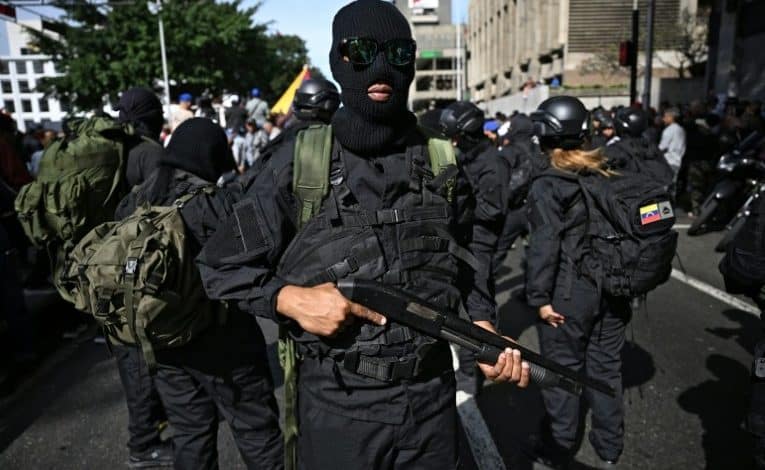
Elsewhere, the city remained subdued. Armed, black-clad security personnel patrolled central districts, while many shops stayed closed. Long queues formed outside a handful of stores that allowed customers in only in small numbers.
Damage appeared largely confined to military installations, where vehicles were seen riddled with bullet holes or burned out. Defence Minister Vladimir Padrino Lopez accused U.S. forces of striking residential areas with missiles and rockets fired from combat helicopters.
Larger wave of strikes could follow
Trump said on Saturday he was “not afraid of boots on the ground” and suggested a second, larger wave of strikes could follow if needed. He also said the United States would “run” Venezuela until a political transition takes place.
Opposition leader Maria Corina Machado said Edmundo Gonzalez Urrutia, whom the opposition says won the July 2024 election claimed by Maduro, should immediately assume the presidency.
Trump dismissed suggestions that Machado herself should lead the country and said he could instead work with Vice President Delcy Rodriguez.
For many residents of Caracas, uncertainty now hangs over what comes next.


