The US and European Union (EU) agreed on a trade deal that ends months of economic standoff between two of the world’s largest trading partners.
The announcement came after a brief meeting between the US President, Donald Trump, and the European Commission chief, Ursula von der Leyen, at Trump’s Turnberry golf course in Scotland.
US-EU Trade Deal
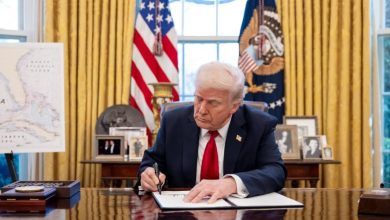
On Sunday, Trump announced a 15% tariff on most imports from the EU nations including automobiles, pharmaceuticals and semiconductors, according to the Associated Press (AP).
Moreover, he said that the EU agreed to purchase, over three years, $750 billion worth of energy from the US, and invest $600 billion more in the US, including major military equipment purchase.
“It was a very interesting negotiation. I think it’s going to be great for both parties,” Trump said, calling the agreement “a good deal for everybody” and “a giant deal with lots of countries.”
Meanwhile, von der Leyen said the deal “will bring stability, it will bring predictability, that’s very important for our businesses on both sides of the Atlantic.”
Working Out Details
The 15% tariff is only half the 30% duties that Trump threatened to impose starting on August 1, 2025. However, the European Commission President said that the deal is a “framework” agreement and details will be sorted out over the next weeks.
Von der Leyen also said that the 15% tariff will not apply to everything, as both sides agreed on “zero for zero tariffs on a number of strategic products.”
These products include “all aircraft and component parts, certain chemicals, certain generic drugs, semiconductor equipment, some agricultural products, natural resources and critical raw materials.”
“And we will keep working to add more products to this list,” she added. However, Trump said that a 50% US tariff he has implemented on steel and aluminum globally will stay in place, according to BBC.
European Leaders Reaction
The European Commission must present the deal to the EU member states and lawmakers, who will make the ultimate decision on approval. With regards to this, European leaders offered a cautious welcome to the deal.
The Irish Prime Minister, Micheál Martin, pointed out that tariffs would still be higher than before, making trade “more expensive and more challenging.”
Meanwhile, Germany’s Chancellor, Friedrich Merz, noted that the deal averted a trade conflict that would have hit the German economy hard. “Stable and predictable trade relations with market access benefit everyone on both sides of the Atlantic, businesses and consumers alike,” he posted on X.
Moreover, Italy’s Prime Minister, Giorgia Meloni, welcomed the deal, but said she needed to see the details, reported Italy’s Ansa news agency.
US-EU Trade Dispute
Earlier in July, Trump announced imposing 30% tariffs on the EU, starting on August 1, as the US and the EU were edging closer toward a deal.
Trump said that that trade deficit with the bloc is a national security threat. He also warned the EU of any retaliatory measures.
In response, von der Leyen said that the EU would take the necessary steps and countermeasures to protect the bloc’s interests, while underscoring commitment to continuing negotiations to reach a deal before August 1.
The EU is one of the US’ largest trading partners, with trade in goods between the two totaling around $976 billion last year. The US imported goods worth about $606 billion from the EU and exported around $370 billion in 2024.