Saudi Arabia’s CEER Opens First Mobile Showroom in Diriyah, Starts Exobot Reservations
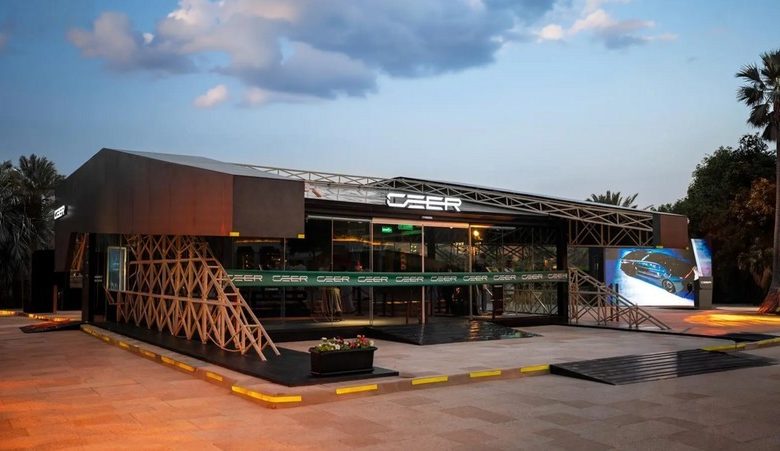
Driving the news: CEER, Saudi Arabia’s national car company, opened its first mobile store on Thursday at Al-Bujairi Terrace in Diriyah. The pop-up launches the first phase of a retail network that will span the Kingdom.
Why it matters: The opening moves Saudi Arabia’s car industry from unveiling to selling. Visitors can now inspect the Exobot sedan and SUV in person. They can also apply to reserve the limited “Exobot – First Edition.”
From Diriyah to the Kingdom: CEER’s Retail Rollout
The store displays the Exobot in both body styles. CEER says Saudi teams designed the cars to the highest global standards. The company built the First Edition around a full-electric system with three motors. Together, they deliver 850 horsepower and 1,000 newton-metres of torque.
The range reaches 670 kilometres. Ultra-fast charging lifts the battery from 10% to 80% in under 30 minutes. Drivers can therefore spend less time at the charger and more time on the road.
The First Edition also carries distinctive details. Buyers get a black exterior package, red brake calipers and Nappa leather seats in red and black. Each car includes an exclusive badge and custom floor mats. A numbered plate matches the car’s chassis number. Customers can choose “Harrat Grey” or “Musk White.”
Both body styles share one price: SAR399,000 ($106,400). The price includes a warranty and services package. It covers the vehicle for six years or 200,000 kilometres. It also includes six years of free scheduled maintenance and roadside assistance. The battery carries a separate warranty of eight years or 200,000 kilometres.
CEER chose Diriyah deliberately. Luay Al-Sharafa, the company’s chief commercial officer, called the opening a new milestone in building a Saudi car industry. He described Diriyah as “the cradle of Saudi cultural identity and national pride, where the legacy of the past meets the ambition of the future.”
“From here, the company presents Exobot directly to its customers, so they can experience for themselves what we make in the Kingdom,” Al-Sharafa said.
Expanding the Saudi Retail Footprint
Zoom in: The mobile store is only the first step. CEER plans more mobile stores before the end of the year. They will open at Boulevard City in Riyadh, Red Sea Mall in Jeddah and Al Nakheel Mall in Dammam. Meanwhile, the company will open flagship centres in Riyadh, Jeddah and Khobar.
The network will cover buying, test drives, delivery, maintenance and spare parts. A dedicated fleet will also provide mobile service and roadside help. CEER says its customer experience draws on Saudi hospitality, from the first contact through the full ownership period. The goal is a smooth, personal experience at every stage.
By the numbers:
- SAR399,000 ($106,400): the single price for the Exobot First Edition, sedan or SUV.
- 850 hp and 1,000 Nm: combined output of the three electric motors.
- 670 km: maximum driving range.
- 10% to 80% in under 30 minutes: ultra-fast charging time.
- 6 years or 200,000 km: vehicle warranty.
- 8 years or 200,000 km: battery warranty.
- 3 cities, 3 mobile stores: Riyadh, Jeddah and Dammam by year-end.
- 240,000 vehicles a year: production capacity of the King Salman Automotive Cluster.
- 45%: the local content target by 2034.
- SAR30bn ($8bn): the PIF’s estimated contribution to GDP by 2034.
- SAR80bn ($21.3bn): the PIF’s estimated trade balance improvement.
- Q1 2027: planned start of regular production
The Public Investment Fund (PIF) and Taiwan’s Foxconn created CEER in November 2022. Crown Prince Mohammed bin Salman launched it as the Kingdom’s first national electric vehicle brand. At that stage, the company targeted first production in 2025. The schedule moved, and the company unveiled the Exobot in September 2026 instead.
Strategic Alignment with Vision 2030
The Crown Prince used the unveiling to underline the strategic goal. He said CEER’s first vehicles mark “another step forward in Saudi Arabia’s progression to build a sustainable and prosperous industrial ecosystem.”
The big picture: Localization sits at the heart of the plan. CEER will build its cars at the King Salman Automotive Cluster in King Abdullah Economic City. The site can produce 240,000 vehicles a year. Moreover, global suppliers have also opened plants in the Kingdom with government incentives. They include Lear, Shin Young, Benteler and Fangxin.
In addition, the company aims to source 45% of vehicle materials and components locally by 2034. BMW supports the engineering effort, and Foxconn leads the electrical architecture. Lucid, another PIF-backed brand, already operates a factory in the same economic city. It opened in 2023. Together, these projects show the Kingdom building a full supply chain rather than a single assembly line.
CEER chief executive Jim DeLuca framed the mission in global terms. “We want to make sure the world can see what Saudi Arabia is capable of,” he said.
Analysts say the stakes extend to consumers. Automotive expert Hashem Al-Fatairji told Al Arabiya that Saudi buyers have long borne the cost of having no local industry. He argued that local production and local supply chains could reshape prices, competition and after-sales service.
What’s next: CEER focuses on the Saudi market first. The company plans regular production in the first quarter of 2027. It will expand into other Gulf Cooperation Council markets in the first half of 2028. Other regional markets will follow. Five more mass-market models should arrive between 2028 and 2030, bringing the range to seven vehicles. The new network supports Saudi Vision 2030 and its goal of a stronger global role in car manufacturing.