
Shaheen Complete: Aramco Launches World’s First Crude-to-Chemicals Plant in South Korea
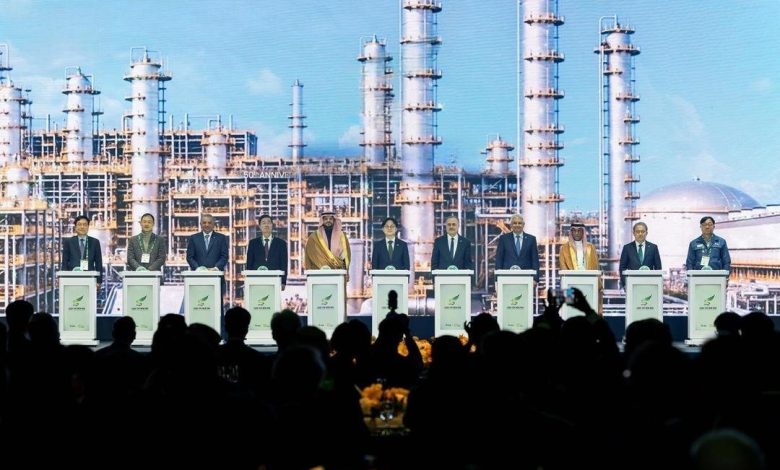
Driving the news: Aramco CEO Amin Nasser said the Shaheen petrochemical project will strengthen South Korean manufacturers and open new markets for the company. S-Oil held a ceremony marking construction completion and its 50th anniversary on Wednesday in Seoul, together with Aramco, its largest shareholder with a 63.43% stake.
Why it matters: Shaheen is Aramco’s largest investment in Korea, and it uses the company’s own thermal crude-to-chemicals technology. Moreover, the project shows how the Kingdom aims to extract more value from every barrel.
An Investment in Advanced Technology
The big picture: Nasser spoke to Korea’s Chosun Ilbo during his visit. He called Shaheen a strategic investment in advanced technologies. These technologies will make chemical products more competitive. In addition, they will open new doors for downstream industries.
The project cost about SAR 26.25 billion (USD 7 billion), or roughly 9.3 trillion Korean won. Nasser stressed that Shaheen does more than expand petrochemical capacity. Instead, it changes how a plant makes chemicals.
He also linked the project to Korea’s most important export sectors. Nine out of ten industrial products need chemical materials, he said. These products include cars, artificial intelligence hardware and semiconductors. As a result, demand for chemicals should keep growing.
How the Technology Works
Shaheen will start commercial operations next year. It should add about 3.2 million tonnes of annual petrochemical capacity, and it should lift petrochemicals from 12% to 25% of S-Oil’s business.
Aramco developed the thermal crude-to-chemicals (TC2C) process. It merges refining and chemical production in one step. Traditional naphtha crackers, by contrast, rely on naphtha from refineries. Shaheen pulls chemical feedstock straight from crude oil and heavy oils. Therefore, the plant skips several conventional processing stages.
Nasser noted one caution. Because Shaheen is the first plant of its kind, real cost savings need testing once commercial operations begin. Even so, he said engineers designed the project to compete globally on price, even after investment costs.
By the numbers:
- 93%: share of raw material the plant converts directly into products.
- 83%: share of feedstock from in-house sources.
- 8 million tones: ethylene capacity of the cracker, the world’s largest.
- 10%: energy-efficiency gain over global leaders, thanks to waste-heat recovery.
- 669,000 barrels per day: capacity of the Onsan refinery that hosts the project.
- 760,000 tones: feedstock that Ulsan petrochemical firms will receive by dedicated pipeline.
- SAR 26.25 billion (USD 7 billion): total investment.
Why South Korea Came First
Aramco chose South Korea as the first commercial site for several reasons. First, its affiliate S-Oil already operates there. Second, the Onsan refinery integrates refining with petrochemicals. Third, Korea hosts advanced chip and auto clusters. Finally, the country serves as an export hub for Northeast Asia.
Nasser sees extra benefits from the plant’s location near customers. Local firms will save on transport, storage and handling. Supply will also move faster. Ulsan petrochemical companies, which imported some feedstock before, will now receive it by pipeline at lower cost. Meanwhile, the Hwaseong semiconductor cluster offers another outlet for Shaheen’s output.
Korea’s Industry Minister Kim Jung-kwan welcomed the project at the ceremony. He said Shaheen would open new paths and possibilities for a domestic petrochemical industry that is restructuring.
Aramco’s Place in the World
The Shaheen launch comes as Aramco holds a commanding global position. It is the world’s largest oil exporter. Its third-quarter adjusted net income rose 9% to SAR 117 billion (USD 31.2 billion). The board also approved a base dividend of SAR 82.1 billion (USD 21.9 billion).
The downstream business shines brightest. Adjusted earnings there jumped 234% to SAR 38.6 billion (USD 10.3 billion) in the quarter, which makes Shaheen’s strategic timing clear. Aramco also kept 2026 capital spending guidance at SAR 187.5 billion to SAR 206.25 billion (USD 50 billion to USD 55 billion).
Furthermore, Aramco is widening its reach beyond oil. It bought a 49% stake in HUMAIN for roughly SAR 9.75 billion (USD 2.6 billion) in cash and assets, which expands its footprint in artificial intelligence.
Energy Security Takes Center Stage
Nasser also addressed supply security. He described the recent Middle East war as the “largest geopolitical crisis” of his career. Nevertheless, Aramco’s supply reliability reached 97.8% in the third quarter. The company kept delivering crude to key customers, including South Korea.
Aramco is preparing to expand the East-West Pipeline from 7 million to 10 million barrels per day, which would strengthen Red Sea export options. Meanwhile, Riyadh and Seoul are discussing a joint oil-storage deal with Korea National Oil Corporation. The plan would raise capacity from 5.3 million barrels to more than 11 million barrels. Aramco calls South Korea a strategic storage hub.
What’s next: Commercial startup comes next year, and the first full results will show whether TC2C delivers promised savings. If it does, Aramco could replicate the model in other markets. For now, Shaheen gives the company a proven showcase and gives Korea a competitive supply base.