Expanded Partnerships: Saudi Education Minister Charts Next Phase of US Academic Ties
A well-educated generation is the cornerstone of a nation’s growth and prosperity. Recognizing this, Saudi Arabia has built a robust education ecosystem, cultivating strong educational ties with countries worldwide.
The US, in particular, has emerged as a close academic partner, building on more than 75 years of educational partnerships. Now, as Saudi Education Minister Yousef Al-Benyan meets US university leaders, the Kingdom is charting the next phase in this partnership, shifting from scholarships to co-designing the future of AI, academic leadership, and scientific research.
A Strategic US Tour
Driving the News: Saudi Education Minister Yousef Al-Benyan has embarked on a visit to the US, accompanied by a high-level education and investment delegation, from November 16-20, 2026.
The Big Picture: The visit focuses on expanding partnerships across the academic, research, and technology fields, as well as exploring investment opportunities in the education sector.
Key Objectives:
- Activate Strategic Partnerships: Operationalize 14 agreements, memoranda of understanding (MoUs), and academic partnerships with leading US universities, research centers, and specialized companies.
- Advance Research and Innovation: Foster joint academic and research programs, facilitate researcher and expert exchanges, and expand collaboration in AI, innovation, and emerging technologies.
- Strengthen Academic-Industry Ties: Engage with US academic and research leaders to co-develop educational programs, build institutional capabilities, and bridge the gap between academia and the private sector.
- Attract Global Investment and Expertise: Draw international investment and specialized knowledge into Saudi Arabia’s education ecosystem while expanding the local presence of American educational institutions.
- Accelerate EdTech and Entrepreneurship: Forge targeted partnerships in education, training, and R&D to leverage cutting-edge expertise in educational technology, innovation, and entrepreneurship.
Stanford & UC Berkeley on the Radar
State of Play: Al-Benyan held separate discussions with the leaders and officials of Stanford University and the University of California, Berkeley (UC Berkeley) to strengthen academic collaboration.
Stanford University
During his meeting with Stanford University officials, Al-Benyan discussed broadening cooperation with Saudi universities, developing educational programs, exchanging knowledge and expertise, and expanding opportunities to draw on specialized academic experience to enhance the global competitiveness of Saudi universities. Furthermore, the Saudi delegation toured the university, visiting the AI Tinkery space, which specializes in exploring AI applications in education.
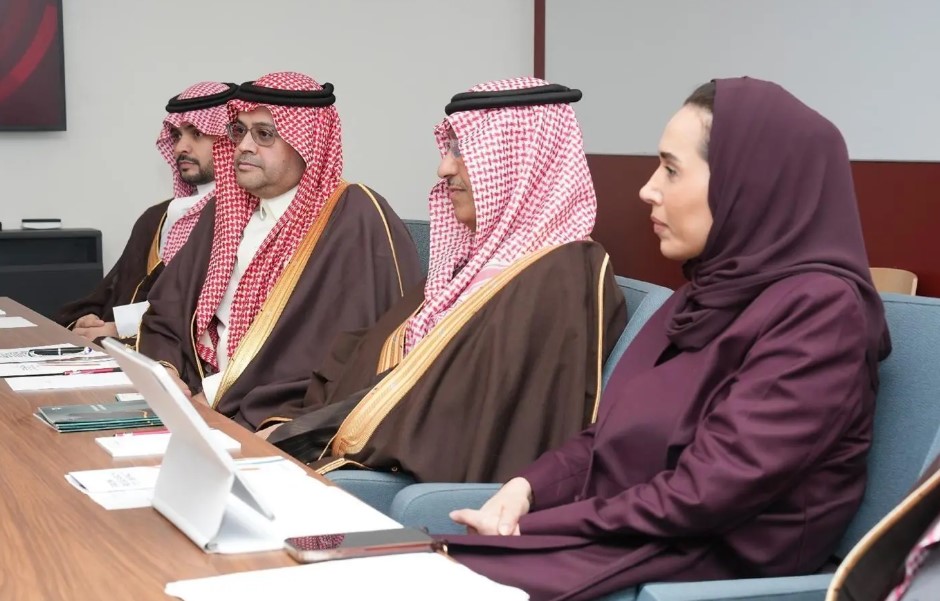
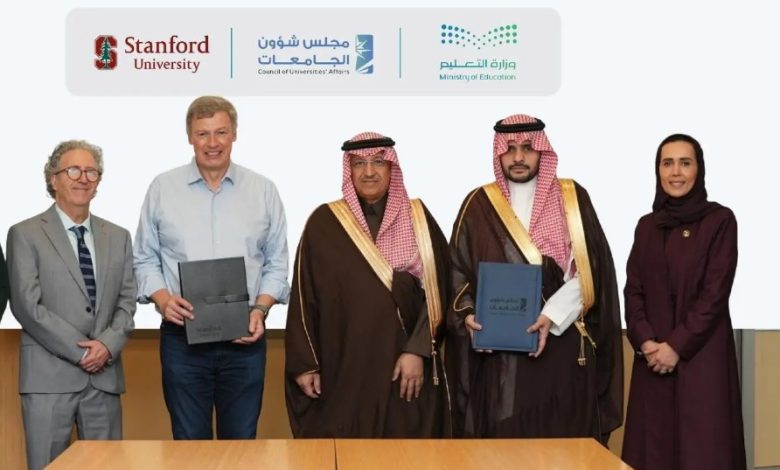
The Outcome: The meeting culminated in the announcement of collaboration between the General Secretariat of the Council of Universities Affairs and Stanford University’s Center for Integrated Facility Engineering to advance executive education and leadership development in Saudi Arabia through Colleges of Excellence.
UC Berkeley
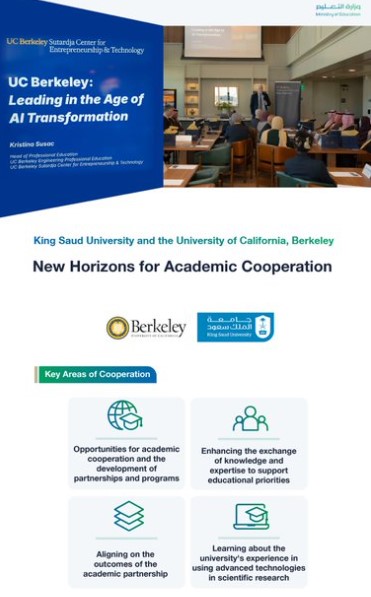
The Saudi Education Minister and officials at UC Berkeley discussed building partnerships and joint academic programs between Saudi universities and UC Berkeley to enhance the quality and global competitiveness of the Kingdom’s higher education sector. Specifically, discussions centered on exploring the impact of AI on education, advancing the science of human development and experiential learning, and translating scientific research outcomes into practical applications. Moreover, a group of Saudi students shared their experiences and perspectives based on their educational and research journeys.
The Impact: The visit opened new horizons for cooperation between King Saud University (KSU) and UC Berkeley on joint programs, knowledge exchange, and aligned partnership outcomes.
Why It Matters: Expanding partnerships with Stanford and UC Berkeley universities – both forming a dual anchor for the Silicon Valley ecosystem – gives Saudi universities direct access to global benchmarks in deep tech, AI commercialization, and entrepreneurial education.
Inside 75 Years of Saudi-US Academic Ties
The Context: Academic relations between Saudi Arabia and the US extend back more than 75 years. As of November 2026, around 8,493 Saudi students are enrolled in American universities, studying medicine, engineering, science, management, and technology, among other disciplines, building a competitive talent pipeline that supports national development.
Mutual Benefits: Under Saudi Vision 2030, this cooperation is expanding beyond traditional student exchanges into broader investments in training, EdTech, and R&D. While the growing Saudi market offers major opportunities for US institutions and companies, American expertise helps modernize educational models, localize technology, and align skills with labor market demands.
By the Numbers: (As of 2025)
- 120+ Research Agreements: Saudi universities, including KAUST, King Saud University, King Abdulaziz University, and King Faisal University, have established more than 120 research cooperation agreements with US institutions, focusing on renewable energy, biotechnology, and artificial intelligence.
- 15+ Active Training Programs: Over 15 specialized training and collaborative programs underway with US universities and research centers, spanning AI, cybersecurity, and clean energy technologies.
The Catalyst: Most Saudi students are studying under the Custodian of the Two Holy Mosques Scholarship Program – an international education initiative aimed at aligning human capital development with economic growth, innovation, and high-demand labor market needs.
It works through four key tracks:
- Rowad Track (Pioneers Track): Aims to send Saudi students to the world’s top 30 global universities across diverse academic disciplines to build future leaders.
- Imdad Track (Supply Track): Targets bachelor’s and master’s degrees at the top 200 global universities and institutions, focusing on specialized sectors required by the domestic job market.
- Research and Development Track: Supports postgraduate researchers and doctoral candidates (Ph.D.) at leading global research institutions.
- Wa’ed Track (Promising Track): Provides study, training, reskilling, and capability-development opportunities in promising sectors and industries to align scholarship outcomes with labor market needs.
Vision 2030 & Human Capital Development
Between the Lines: The Saudi Education Minister’s visit to the US directly aligns with Vision 2030’s goal of transforming the Kingdom into a competitive, knowledge-based economy powered by world-class education and research.
The Anchor: These efforts are led by the Human Capability Development Program (HCDP), one of Vision 2030’s key programs focusing on matching educational outcomes to the needs of the labor market to empower Saudi citizens and unlock their full potential.
The Bottom Line: Building on 75 years of academic cooperation, Saudi Arabia’s expanded partnerships with Stanford and UC Berkeley transform decades of educational exchange into a powerful engine of knowledge-based economic leadership in line with Vision 2030.