Saudi Arabia Uncovers 125,000-Year-Old Evidence of Human Life in Empty Quarter
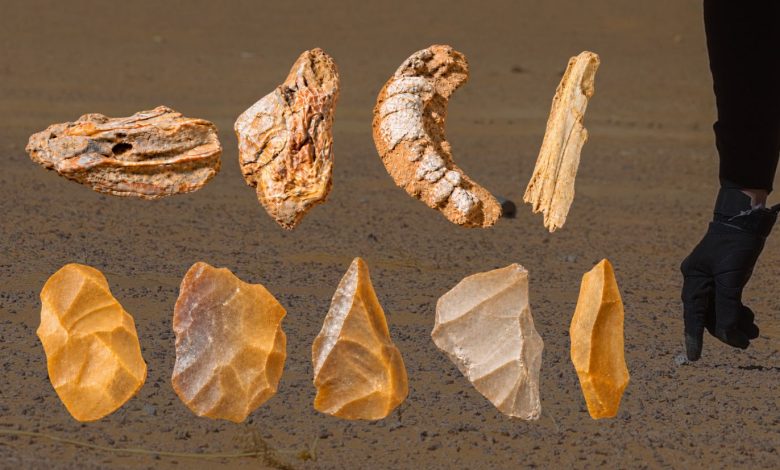
Today’s Empty Quarter offers rare glimpses into the landscapes that once existed beneath its shifting sands.
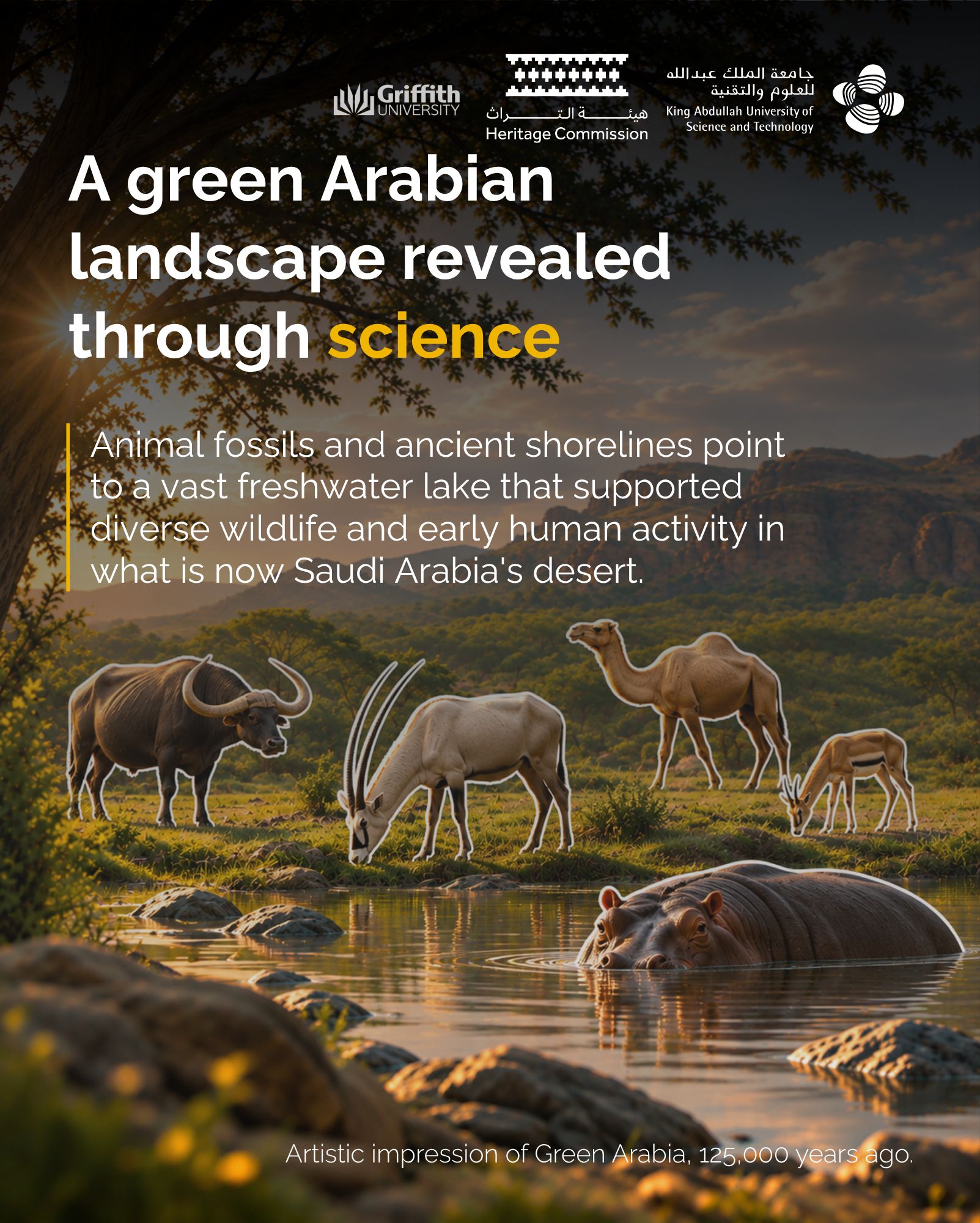
Yet, approximately 125,000 years ago, a humid climate brought freshwater environments and vegetation to parts of the Arabian Peninsula, supporting wildlife and human communities around ancient lakes.
A Lost World Beneath the Sands
One of the places preserving evidence of this distant environment is Uruq Al-Julaybah, nestled along the former shores of Mundafan Palaeolake in Najran Region.
A new study unveiled by the Saudi Heritage Commission, with contributions from Griffith University, KAUST and other national and international research institutions, has unearthed stone tools and animal and plant remains signaling human activity in the area during this prehistoric period.
Published in Science, the study defines a landscape markedly different from the arid environment that features the Empty Quarter today.
Covering nearly 340 square kilometers and reaching depths of up to 29 meters, Mundafan Palaeolake once formed a relatively stable freshwater ecosystem, driven by open grasslands and vegetation that supported a wide range of human and animal life.
Who Lived Around This Ancient Saudi Lake?
Notably, sedimentary and geomorphological evidence, together with the remains of aquatic organisms, helped researchers recognize the lake’s environmental conditions.
More than 130 locations across the site yielded over 500 vertebrate and invertebrate fossils, such as hippopotamuses, extinct long-horned buffalo, camels, Arabian oryx, gazelles and ostriches, alongside mollusks and freshwater crustaceans known as ostracods.
Together, these discoveries highlight the ecological richness of the region during the humid phases of the Pleistocene epoch.
How Did Early Humans Make Their Tools?
Crucially, the archaeological record also offers insight into the technological abilities of the people who inhabited the lake’s shores.
Researchers recovered 5,511 stone artifacts, each measuring more than two centimeters, from the primary study area, with flint accounting for over 98% of the finds.
Analysis also indicated that these tools were produced using the Levallois technique, an advanced method of stone-tool production associated with the Middle Paleolithic.
By carefully preparing the surface of a stone core, prehistoric toolmakers could determine the shape and dimensions of the flakes and points they produced.
Evidence that these implements were both manufactured and used at Uruq Al-Julaybah suggests that the site served as a vital place of active tool production and everyday human activity.
Tracing the Everyday Lives of Early Humans
Despite the fact that surface erosion has affected the site over time, the distribution of stone tools alongside fossil deposits and preserved organic remains points to repeated human occupation over an extended period.
Further examination of the artifacts through microscopic, chemical and use-wear analyses provided glimpses into the traces of plant fibers, wood, resins, fats and collagen, offering clues to the range of activities carried out around the ancient lake.
More tellingly, some of these findings signal the processing of palm and other woody plants, suggesting that early inhabitants used locally available vegetation for different practical purposes.
Researchers also identified impact fractures and traces of hafting on several stone points, indicating that some tools were attached to handles.
Why Did Early Humans Settle Around the Lake?
Remarkably, the research builds on fieldwork carried out throughout the 2023 season under the supervision and funding of the Heritage Commission.
Dr. Ajab Alotaibi, Director General of the Antiquities Sector at the commission, highlighted the commission’s role in overseeing archaeological surveys and excavations, while emphasizing its commitment to strengthening multidisciplinary research through partnerships with Griffith University, KAUST, King Saud University and specialized international research centers.
Dr. Abdullah Alsharekh of the Department of Archaeology at King Saud University’s College of Tourism and Archaeology explained that the combination of freshwater, abundant wildlife, vegetation and accessible raw materials made the shores of Mundafan Palaeolake a favourable environment for human communities around 125,000 years ago.
These resources supported a range of activities, from stone-tool production and hunting-equipment preparation to processing natural materials and working with plant fibers.
Rewriting the Story of Human Settlement in Arabia
The significance of Uruq Al-Julaybah extends beyond the individual discoveries, contributing to a broader understanding of how early human populations inhabited the Arabian Peninsula under changing environmental conditions.
In this context, Prof. Michael Petraglia of Griffith University, noted that the findings enhance our knowledge of prehistoric settlement patterns, particularly during humid periods that created favourable conditions for human habitation.
Similarly, Dr. Frans van Buchem of KAUST emphasized the contribution of interdisciplinary research, indicating that collaboration across scientific specializations enabled a more detailed reconstruction of ancient human behaviour and environmental conditions.
The research aligns with the Heritage Commission’s broader push to document the Kingdom’s archaeological history through advanced analytical techniques and international scientific cooperation, examining the relationship between human settlement and long-term environmental transformation.
Related Topics:
Heritage Commission Launches Documentary Spotlighting Underwater Cultural Heritage
Saudi Heritage Commission Unearths 147 Architectural Units in Al-Ahsa
MODON, Heritage Commission Partner to Support Artisans, Craft Sector