KAUST Unveils NESCOD: Electricity-Free Cooling Breakthrough for Hot Climates
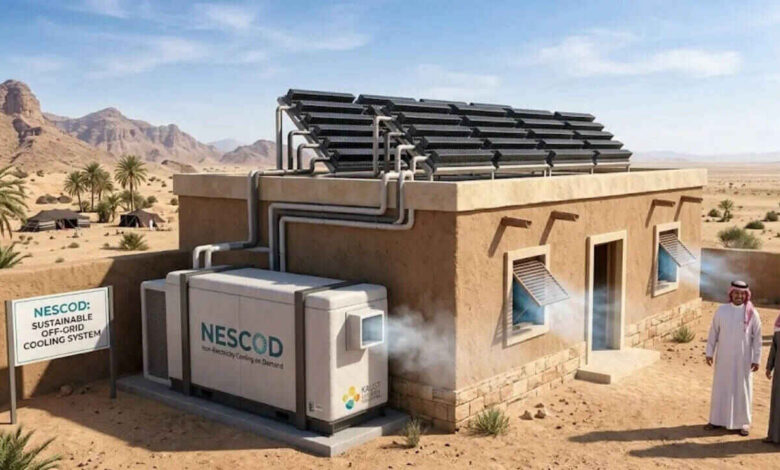
Researchers at King Abdullah University of Science and Technology (KAUST) have developed NESCOD, a passive cooling technology that operates entirely without electricity. The system offers a sustainable alternative to energy-intensive air conditioners, targeting communities in remote regions and extreme heat zones across the Gulf and beyond.
NESCOD captures solar energy and stores it for later use in cooling. Consequently, it can eliminate electricity costs tied to refrigeration and reduce dependence on diesel-powered cooling systems common in disaster-prone and off-grid areas. The Royal Society of Chemistry published the findings, which confirm a cooling output of up to 191 watts per square meter under standard conditions.
How the System Works
The NESCOD system operates through a two-stage thermodynamic cycle. First, it utilises dissolution cooling. Second, it employs solar-driven solute regeneration. During the cooling cycle, the process dissolves ammonium nitrate in water. This endothermic chemical reaction rapidly absorbs heat from the surrounding environment. As a result, the liquid’s temperature drops quickly.
Second, a 3D solar regenerator uses sunlight to evaporate water from the salt solution. As the water vapour rises, the ammonium nitrate recrystallises, effectively recharging the system. Therefore, the cooling effect remains available at night or across seasons, since dissolution and regeneration occur independently.
Consistent Performance and Low Cost
Under one sun of solar illumination, NESCOD evaporates water at roughly 2.2 kilograms per square meter per hour. This maintains temperatures between 5°C and 15°C, a range suitable for cold-chain food storage and space cooling. Moreover, the system captures water vapour and recycles it with impurity levels below 1 ppm, making it valuable in water-scarce environments.
Ammonium nitrate, the system’s key material, already sees widespread use in fertilisers, keeping costs low and supply chains accessible. The 3D solar regenerator’s compact architecture also delivers high evaporation rates with a small footprint, reducing material costs per cooling unit.
As a result, KAUST researchers say NESCOD is a strong candidate for large-scale deployment in developing nations where traditional electricity infrastructure remains too expensive or unavailable. The technology represents a meaningful step toward accessible, eco-friendly cooling for the world’s most vulnerable communities.