Hajj is one of the five pillars of Islam. It is obligatory for all able-bodied Muslims who can afford it, at least once in their lifetime.
Hajj is a spiritual experience for Muslims, which involves undertaking a set of rituals performed by Prophet Mohammed PBUH centuries ago. It takes place during the first ten days of Dhu’al-Hijjah, the final month of the Islamic calendar.
In this regard, Leaders MENA Magazine offers a detailed guide to Hajj rituals day by day. The first step is Ihram and choosing the type of Hajj.
Step 1: Ihram
Before arriving in Makkah, pilgrims must assume Ihram. It is the sacred state a pilgrim must enter before carrying out the rituals of Hajj and Umrah.
On the plane, pilgrims will pass by places called “Miqat.” Before entering Miqat, they must declare their intention to undertake Hajj, and perform Talbiyah by saying: “Labbayka Allahumma labbayk, Labbayka laa shareeka laka labbayk, Innal hamda wan-ni’amata laka wal mulk, laa shareeka laka.”
Essential Hajj Rituals: A Step-by-Step Guide#No_Hajj_without_a_permit #Hajj_1445H #Ease_and_Tranquility pic.twitter.com/tSvtPHihcH
— Leaders MENA (@leadersmena) June 10, 2024
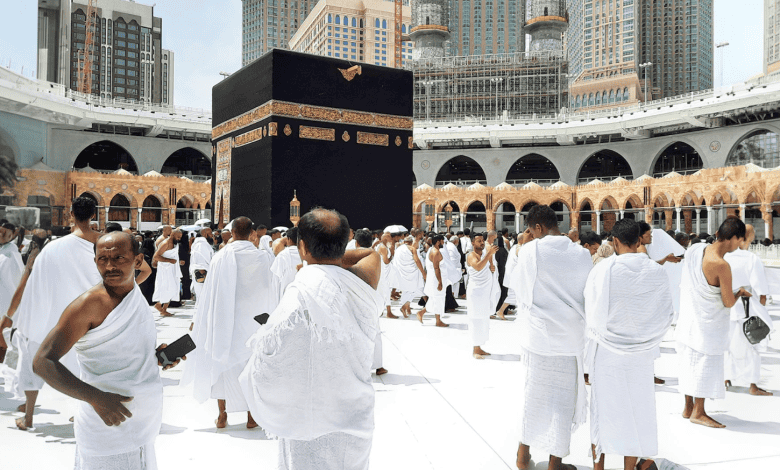
Once they assume Ihram, pilgrims perform ablution, wear Ihram clothes. Male pilgrims wear two white seamless clothes. Female pilgrims are allowed to wear any white modest dresses.
During Ihram, pilgrims refrain from all prohibited activities, including sexual intercourse, wearing perfumes, cutting nails, shaving and slaughtering animals over the duration of the pilgrimage.
Further Instructions
Menstruating women can assume Ihram. It is recommended that pilgrims stipulate the purpose of Ihram while making the intention, specifying whether it is for Hajj or Umrah. If they are performing Hajj, they should also indicate the type of Hajj.
If the pilgrim feels that something may hinder the performance of Hajj or Umrah, such as illness, he can add the following stipulation to his intention, by saying: “I intend Hajj and Umrah, and I assume Ihram for the sake of Allah, Allahumma labbayka Hajj and Umrah, and if an impediment prevents me, then, I will dissolve (my Ihram) wherever/whenever You (O Allah) prevent me.”
Pilgrims may take off their Ihram clothes and wear another, if necessary. Hajj remains valid if any prohibition is committed, except for sexual intercourse. In this case, the pilgrim shall be obliged to pay a Fidyah (expiation).
Miqaat
Miqaat is the appointed time or place for something. There are two types of Miqaat: temporal and spatial. Hajj has specific Miqaats, Shawwal, Dhul-Qi’dah, and the first ten days of Dhu’al-Hijjah. Umrah can be performed at any time throughout the year.

There are spatial Miqaats for people coming from other countries. Every pilgrim must assume Ihram from the Miqaat he passes by on his way. If they assume Ihram after they go past this Miqaat, they must offer a Fidyah.
Designated Miqaats are:
- Dhul-Hulaifah (Abyar Ali): It is the Miqaat of the people of Madinah and those who pass by on their way. It is 420 km away from Makkah.
- Al-Juhfah (Rabigh): It is the Miqaat of the people coming from North America, Europe, Turkey, Syria, Egypt, Algeria, Sudan and several other African countries. It is 187 km away from Makkah.
- Qarn Al-Manazil (Al-Sail Al-Kabeer): It is the Miqaat of the people of Najd and those who pass by on their way (the U.A.E, Oman, Pakistan, Australia, Malaysia, Singapore). It is 94 km away from Makkah.
- Yalamlam (Assa’diyyah): It is the Miqaat of the people of Yemen and those who pass by on their way (South Africa, Nigeria). It is 115 km away from Makkah.
- Dhat ‘Irq: It is the Miqaat of the people of Iraq and those who pass by on their way (Iran, China, Russia). It is 92 km away from Makkah.
Types of Hajj
Pilgrims can choose between three types of Hajj. The first is ‘Hajj al-Ifrad’, which refers to performing the rituals of Hajj only. In this type, sacrificing an animal (Hadee) is not obligatory. The performer of this type is called ‘Mufrid’.
The second type is ‘Hajj al-Qiran’, where a pilgrim (Qarin) performs Hajj and Umrah together with one Ihram for both. A Qarin must slaughter a ‘hadee’ to complete the rituals. Assuming Ihram for Hajj and then entering Ihram for Umrah renders the Ihram for Umrah invalid.
The third and most common type is Hajj ‘al-Tamatt’u’. Prophet Mohammed PBUH encouraged his companions to perform it. The pilgrim (Mutamatti) assumes Ihram for Umrah rituals during Hajj season, then releases himself from Ihram and enters Ihram for Hajj. He is required to sacrifice a hadee.
- This is a republished story. Please note that the Hajj rituals for this year begin on June 4, 2025 (the 8th day of Dhu al-Hijjah).
Related Topics:
How to Avoid Heatstroke during Hajj?
To Avoid Food Poisoning during Hajj, Some Tips to Stay Healthy