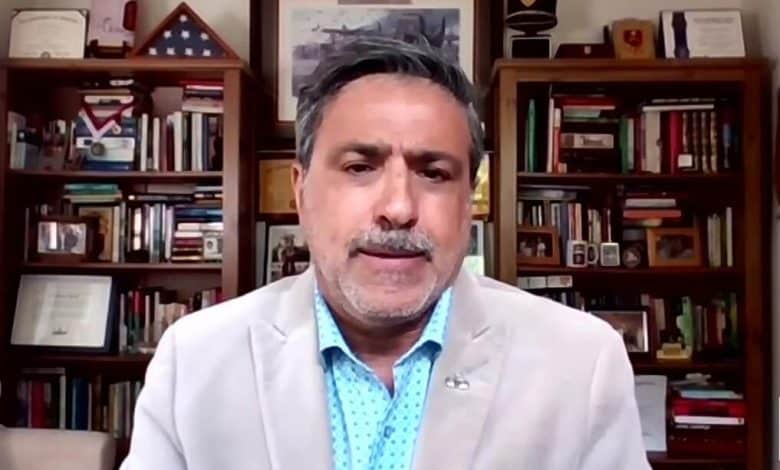
Escalating tensions between Washington and Tehran dominate regional discourse, prompting widespread concern. Colonel (Ret.) Abbas Dahouk, former Senior Military Advisor to the US Department of State, recently offered a compelling analysis to Asharq news channel. He warned that escalating U.S.-Iran tensions could erupt into military conflict if nuclear negotiations collapse. His assessment follows President Donald Trump’s secret letter to Iran’s Supreme Leader Ayatollah Ali Khamenei, setting a two-month deadline for a new nuclear deal—or face consequences.
When asked about the current state of negotiations, Dahouk stated, “This is, in other words, the pressure part. Whether it is a pressure paper before the sixth round of talks, or an attempt by both parties to communicate.” He highlighted that the United States demands Iran halt its nuclear activities, which Iran considers a red line. This fundamental disagreement complicates the diplomatic landscape.
Dahouk noted, “At this point in time, it is not clear, but developments like this, whether it is a temporary curfew or a full curfew in the region, are serious threats.” He underscored that these military movements should not be taken lightly, indicating a potential escalation in tensions.
Military Options on the Table
The discussion shifted to the military options available to the United States. Dahouk affirmed, “The military option is on the table, as we know, and the army is ready.” He explained that if President Trump perceives negotiations as futile, he may resort to military action. “If the diplomatic option fails and sanctions do not yield results, there is no choice but to implement a military operation,” he added.
Dahouk also speculated about the possibility of Israel’s involvement. He stated, “We do not know if the United States will act alone or in cooperation with Israel.” This uncertainty adds another layer of complexity to the already tense situation.
Iran’s Response to Potential Attacks
The conversation then turned to Iran’s potential response to military actions. Dahouk asserted, “Iran will certainly defend itself. It has proven its capabilities against Israel.” He emphasized that Iran can target not only Israel but also US military bases throughout the region. “They have shown they can act directly or through proxies like the Houthis and Hezbollah,” he explained.
He further stated, “If there is an attack against Iran, they are ready to respond at any time.” This readiness to retaliate underscores the precarious nature of the current geopolitical climate.
Behind the Scenes of US-Iran Relations
Reflecting on the dynamics between the US and Iran, Dahouk discussed President Trump’s recent statements. He noted, “President Trump thinks that Iran is lying and taking negotiations lightly.” This perception complicates the diplomatic efforts and increases the likelihood of military action.
Dahouk also pointed out the pressure on the Israeli government to act against Iran. “The Israeli government wants to do something, and there is internal pressure to move,” he stated. This urgency may push both Israel and the United States toward a military solution.
In conclusion, Colonel Dahouk provided a comprehensive analysis of the current military tensions between the US and Iran. His insights reveal a complex interplay of diplomatic negotiations, military readiness, and regional dynamics. As the situation evolves, the world watches closely, anticipating the next moves from both Washington and Tehran.
Dahouk’s remarks serve as a reminder of the fragile state of international relations and the potential consequences of miscalculation in this high-stakes environment.